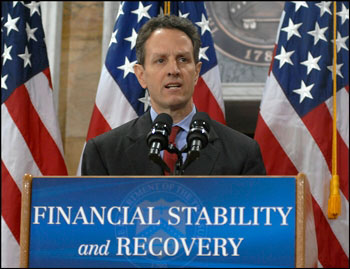
It official, the United States has hit its Debt Ceiling today according to Treasury Secretary Timothy Geithner. So what about this august 2 deadline? Geithner has figured out he can stretch the existing Debt Ceiling until then by deferring required payments into various federal retirement funds. While he assures federal retirees that in no way would they feel any effect of the deferred payments, in fact he is incurring additional obligations with the federal government itself. Basically he is doing the same thing as if a home owner delayed paying their property taxes for a few months knowing that such a delay would not result in a default. Yet if a public company did exactly this, they would be required to post it as a liability on their balance sheet consistent with GAP.
Secretary of the Treasury Timothy Geithner Hits Debt Ceiling
Yes, I know this is government and the rules do not apply, and to try and figure out why the rules do not apply would kill far too many brain cells. Yet the question remains, why delay until August and not face the music today? Might it have something to do with the fact traditionally Congress is not in session then and the Administration may be hoping that members may cave in on their demands in order to take their summer vacations? Might it be that the news in August is generally dead and it is the lowest rated month for news outlets? Maybe it’s just the government tendency to never do today what can be delayed until tomorrow. Regardless, the Government is tapped out on its credit cards and needs to deal with the root cause now, not later.
Way back in late 1999 (yes it was a long time ago) I became a regular reader of a great website called Voter.com which was a blog style site with prominent contributors from all perspectives mostly discussing the upcoming 2000 presidential election. Now Voter has long since disappeared, replaced by left or right dominated sites (welcome to the echo chamber) and more developed sites like Real Clear Politics or the Politico. But one gem has survived, The Battleground Poll, and now finds its home at The Politico and is sponsored by George Washington University. What makes Battleground special is it is a relatively deep poll with approximately 1,000 likely voters and is jointly conducted by Republican Pollster The Terrance Group and Democratic Pollster Lake Research Group. Additionally Battleground has an extensive set of relative questions and is very transparent in the polling methodology.
The current version offers an interesting insight into the minds of the American electorate that offers hope and caution to those of us who support the Republican Party, and also Democrats. On the surface, it appears Americans have endorsed divided government with the generic congressional ballot at 39 percent Strongly Democratic and 3 percent leaning Democratic while 37% Strongly Republican and 5 % leaning Republican and 16% expressing no opinion. In the November 2010 election the actual vote gave the republicans a 5 percent lead. On Job approval President Obama has a reasonable level of support with 34 percent Strongly Approving of his job performance, 18 percent Somewhat Approving, 34 percent Strongly Disapproving and 10 percent Somewhat Disapproving. This shows that the truly partisan sides are essentially equal, with 34 percent strongly Approving and Disapproving it’s those who feel less sure that seem to be driving the dynamic. It also seems the President received very little bound for Killing OBL. One cautionary note is the level of personal support President Obama has with 48 percent Strongly Approving of him and 24 percent Somewhat Approving as opposed to 15 percent who Strongly Disapprove and 4 percent who Somewhat Disapprove. This message is clear, the path to defeating Barak Obama rests in contrasting his policy positions and job performance as President, not is personal attacks. Really this is not a surprise since most Americans of all political affiliations genuinely want the President in office to succeed and support the office if not the occupant.
It is when you begin to look at the issues that it becomes clear the electorate is not in a good mood at all and the Administration is on the wrong side of many of the issues. To put it bluntly we as a people are scared of our economic future with 73 (58 strongly/15 leaning) percent feeling the next generation will be worse off than the current and just 24 (13/9) being optimistic for the next generation. This level of pessimism is almost without precedence and consistent with many other polls. Americans favor repealing the Healthcare Reform law 49 (37/12) percent to 42 (30/12) percent. Without any doubt the voters are focused on the economy and when asked what the single most important issue to them is, 28 percent respond the economy and jobs and 20 percent reply government spending and the budget deficits. This swamps all other issues in the poll. Please note this poll asked dozens of other questions and is packed with interesting data making it well worth a good solid read.
Inside this poll is a roadmap to the 2012 election for those who take the time to think about how the people feel. Personal attacks against any of the candidates are much less likely to gain traction than directly addressing and contrasting positions on economic issues. Addressing the current economy and real private sector job creation is what the voters seek. It seems people have become focused on how the threat the debt poses to the very future of the country. In many ways this is a flashback twenty years to the 1992 election and that campaign may provide a guide to victory. Lastly I think Healthcare poses a threat and opportunity to the GOP. While a plurality favor repealing it, a strong majority feel it went too far. Thus a proposal which did not simply propose repealing the law but contained real free market reform would significantly increase the popularity of such policies. Additionally comprehensive free market healthcare would prevent the leftists from trying to socialize healthcare down the road when they inevitably gain power again. Let’s just hope our candidates for the nomination keep the focus on the economy, in doing so they will ensure the retirement of Barak Obama.
With Mike Huckabee’s decision not to seek the Republican presidential nomination coming on the heels of Haley Barbour’s three weeks ago and other prominent Republicans such as John Thume, Bobbie Jindel and Jeb Bush taking themselves out one has to wonder why they are being so hesitant. Indeed one would have the feeling that they were seeing the same political landscape the Democratic candidates were seeing in May 1991 when George H.W. Bush was at 91 percent approval. Are those of us on the right drinking our own kool-aid and ignoring some political strength of President Obama that would make him a lock for reelection? So it’s time to not talk about positions and take a look at the numbers, the picture they paint is interesting.
Right from the start let’s look at the number that many feel is the single best predictor of the overall political climate, the differential between those who consider the country to be on the right track or the wrong track. Using the real clear Politics averages, this is currently at those feeling the country is on the right track of 35.0 percent and those feeling it is on the wrong track at 56.4 percent, an almost unprecedented -21.4 percent differential and a number which has remained relatively constant since last fall’s midterm elections. Regardless of their public statements, this has to cause president Obama’s political advisors considerable heartburn as they plan for the campaign. The RCP Presidential Approval average stands at 51.4 approval and 42.6 disapproval reflecting a modest 5 or 6 percent bounce the president received after the elimination of OBL. Like the right track/wrong track this has been relatively stable since the summer of 2010. In head to dead match ups with hypothetical republican candidates the RCP averages show Obama leading by 5.8 percent against a generic Republican. To be blunt, these are not the numbers of a President who is a sure bet, if there is such a thing, for reelection. Most incumbents have strong double digit leads against generic opponents since there is always a stature gap which is only addressed once a challenger wins their nominations.
Perhaps more telling are not the political numbers, but the economic since as James Carville famously told us, “It’s the economy stupid”. Here the story is much more problematic for the administration and perhaps more predictive of the political climate in 2012. Using Bureau of Labor Statistics Numbers, Unemployment in April was 9.0 percent, with 205,000 more people on the unemployment rolls and likely many more “long term unemployed” who are not looking or underemployed. This number has been locked in a one prevent band for over 2 years now and seems to experience resistance when it challenges 8.5 percent. One political fact, no president has been reelected with unemployment over 7.5 percent in the modern era, period. The recovery is indeed a recovery, the US economy has had positive economic growth for the past 7 quarters, but the 1.8 percent annual growth rate in the first quarter of 2011 offers the president nothing to rejoice about.
Please understand I am not trying to create some form of predictive model, with 17 months until the 2012 general election anything can truly happen, but what we have is a landscape of what is likely to be a very competitive election. So why have a number of candidates stepped back after flirting with running this year? Part of it may be the rough treatment any republican is likely to receive from a media which remains very much President Obama’s booster club. Part of it is while the landscape is that President Obama seems likely to raise One Billion Dollars, which is an unimaginable war chest for any challenger to raise. All that having been said, let those who are not totally committed walk away now. As former speaker Tip O’Neil famously said, politics ain’t bean-bag. You do not get to the white house without a singular focus to get there. At the risk of using too many quotes, let me close with Speaker O’Neil’s nemesis, President Ronald Reagan, “the future doesn’t belong to the fainthearted, it belongs to the brave”. So let’s see who has what it really takes to earn a ticket to the race which will determine who sleeps in the white House on the night of January 20, 2013.
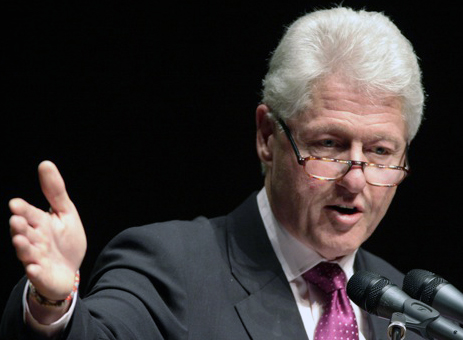
Bill Clinton was interviewed on CNBC’s “Closing Bell with Maria Bartiromo” this past Friday and made a proposal which deserves some discussion; Bill Clinton is concerned with the sheer volume of rumor and misinformation which exists on the internet. This is indeed a problem that many of us have with the internet, particularly the ability of misinformation to be seen by some as fact simply by sheer volume. However Clinton has an innovative solution which is both naive and of great concern. He has prepossessed that the United Nations ideally, or the US government if the UN was unable to act, would set up an autonomous agency to combat internet misinformation.
Former President Bill Clinton Proposes a UN Internet Agenecy to Fight Misinformation
When I read about this in the Politico I took a double take to see if I in fact had read the article correctly. This was one of those articles which was even more concerning the more the magnitude and implications of the former president’s suggestion was considered. The mere existence of any government agency which had as its mandate to determine truth in what has become a global forum congers the image of third world dictators or the Chinese Communists who attempt to control what their people read on the internet. Clinton was vague as to the powers of this global internet cop, but even if it was just there to “correct” misinformation is beyond disturbing. He went to pains to say this agency must be run by an independent administrator who would be both respected and seen as independent from any government. Yet the concept of a government stepping into tell the media what it truth and what is misinformation is offensive in any democracy.
Of greatest concern is his proposal to have the United Nations be the “government” which would empower and manage this agency. The UN is not a government and lacks any authority to act as one. One of the most significant legal debates in the United States in recent years has been the relevance and authority of foreign legal positions on US law. Under our Constitution the answer would appear simple, there is in fact no role and the constitution itself is the highest legal authority in America. One cannot imagine any such agency surviving a judicial review as to its constitutionality under the first amendment. Freedom of speech, even offensive and questionable speech, is fundamental in any democracy, period.
Clinton’s proposal also displays his ignorance of the manner in which the internet operates. The Chinese Communists have been trying to control the ability of their citizens to access content critical of the regime or calling for democratic reform. As quickly as a barrier is put up, those seeking freedom find a way around the blockage. Indeed none other than Secretary of State Hillary Clinton backed efforts to help internet dissidents in China to break down the government’s “Great Firewall” several months ago. Attempting t block information on the interne t is like putting your figure in a Mississippi levy to stop the approaching flood. He also neglects the internets tendency to correct itself by the sheer volume of discussion and analysis by the many choices in existence. One need only look to the development of Wikipedia which has been manipulated with misinformation, yet over time it is corrected by the volume of contributors in a collaborative process.
What was in Clintons mind when he made this proposal is imposable to know but it must be taken very seriously by those who value freedom. Government censorship if a cancer on democracy and must be fought and defeated wherever it raises its ugly head. Furthermore the viewing of the United Nations as some form of Global Government is a concept which must be rejected in the most definitive way. If Bill Clinton truly meant this then he has taken a step in a direction which is dangerous to our very democracy.
It seems former Arkansas Governor Mike Huckabee has joined the likes of former conservative Joe Scarborough and deciding he likes work in a Manhattan TV studio over running for elective office. Combined with the disastrous week Mitt Romney had where rather than putting the Romneycare issue to bed he has awakened a potentially deadly curse on his campaign. I suspect that the attention of may will now focus on Indiana Governor Mitch Daniels. However I suspect the door is now opened for some of the second tier candidates such as Herman Cain, Rick Santorum or even a yet to be announced candidate such as Ruddy Giuliani to enter the race. However it plays out I suspect it’s not going to be boring!

 A Conservative's Musings on All Things Political